Ritsu is the AI tutor that trains you to deeply understand, practice, retain, and apply whatever you're learning. Drop in a textbook chapter, slide deck, YouTube video, or paper — and get coached step by step.
The top 1% aren't smarter. They study differently.
Most courses teach you what to learn — not how to learn it. Strong learners rely on a system of twelve study habits. Most students use only a few of them consistently.
Twelve study habits: how most students run them, how the top 1% run them, and what Ritsu does for each.
Activity
Most students
The top 1%
Ritsu
Reading / watching
Rereading, highlighting, rewatching
Recalling it without looking
Makes you recall as you learn
Understanding
Assuming you understood
Asking questions from every angle
Questions you from every angle
Study plan
No plan — whatever's due next
A structured path, broken into small units
Builds that path from your material
Problem sets
Reading the solution. Or asking AI.
Solving. Checking. Distilling. Applying.
Solve first. Feedback second.
Review
Cramming the night before
Review timed to the forgetting curve
Brings concepts back for spaced review
Mistakes
Reading the right answer, moving on
Finding the misconception behind it
Diagnoses the misconception, then makes you retry
Papers
Reading until you're lost
Rebuilding the argument, step by step
Makes you rebuild the argument
Progress
A feeling: "I think I know it"
A score on every concept
Scores mastery concept by concept
Practice
Practicing at the end, if there's time
Practicing from day one, at the weak spots
Targets practice at your weak spots
Structure
Notes, chapter by chapter
A concept map of the subject
Maps how every concept connects
Depth
Taking it at face value
Why. What if. What breaks it.
Keeps pushing with why and what-if
Tools
A textbook and a chatbot
A system: recall, spacing, mapping, testing
Runs the whole method in one workflow
swipe to compare →
Solution
Four simple steps to close the gap.
Put in anything you're studying, and Ritsu will coach you until it's yours.
1
Drop it in
Your chapter, your slides, your lecture recording. No formatting. No prompting.
2
p.5
Get your plan
The chapter comes back as an ordered path of small units — every item traced to the page it came from.
3
/quiz
Learn every concept
40+ commands turn learning science into interactive activities. They help you /test, /explain, /quiz, and /solve problems until you understand deeply.
4
Watch it fill in
Every concept gets a score. The map lights up as you master it — and what starts to fade comes back before you lose it.
Every course from here on
Learn like a top student.Master what others only study.Join the top 1%.
Build a better way to learn once, then carry it into every course — deeper understanding, stronger recall, sharper problem-solving, and a learning advantage that keeps growing.
week 1
Week 1: Learn like top students do.
Ritsu guides you to understand, recall, question, practice, and apply — the way strong learners study.
week 6
Week 6: Master what others only study.
Don't stop at “I get it.” Explain it, connect it, solve with it, and use it until you truly own it.
week 12
Week 12: Join the top 1%.
Learn at a higher level — and let it show in what you understand, solve, and achieve.
Forty-two commands, each one a method from learning science, all running on your own chapter, slide deck or lecture recording. Nothing to set up. Nothing to make.
Your study plan
A study plan built from your own chapter.
Top students break the material down before they start. Drop in a chapter, a slide deck, a lecture — Ritsu cuts it into small units and puts them in the right order, with your progress on top. There's nothing left to plan. You just follow the path.
Auto-built path
Ordered by difficulty
Page citations
Progress tracking
chapter_04.pdf
1 · What a neuron computesp.2
2 · Weights and biasesp.4
3 · The loss surfacep.7
4 · Gradient descentp.9
5 · Backpropagationp.12
Deep understanding
Deep understanding. Not just familiarity.
Top students don't stop at what. Ritsu pushes the same way they do: asking /why until you reach the reason, challenging you to /explain it in your own words, tying it to something you already know. You stop borrowing the idea. You own it.
/why
/explain
/analogy
/derive
/intuition
/eli5
/why is there a minus sign?
Because the gradient points uphill —
— and we want the loss to go DOWN, so we step against it.
the reasonThat minus sign in w ← w − η∇L IS the whole idea.
Learning commands
42 commands. One for every way you need to think.
Top students don't have one study move — they have a dozen, and know which one to use when. Ritsu names all of them: /quiz, /mindmap, /timeline, /diagram, /code, /crossword. A chatbot gives you a box to type in. This gives you a vocabulary.
/quiz
/mindmap
/timeline
/diagram
/code
/crossword
+36 more
42 commands available.
/quiz
/mindmap
/timeline
/diagram
/code
/crossword
/why
/explain
/analogy
/quiz
/mindmap
/timeline
/diagram
/code
/crossword
/why
/explain
/analogy
/quiz
/mindmap
/solve
/explain
/timeline
one keystroke
/derive
/intuition
/eli5
/solve
/prereq
/what-if
/askme
/contrast
/flashcard
/derive
/intuition
/eli5
/solve
/prereq
/what-if
/askme
/contrast
/flashcard
Problem sets
Learn from the problem. Not from the solution.
Top students attempt it cold, then check. /solve holds the solution back until you've written your attempt — then grades it, shows you where it broke, and makes you redo it. Reading a solution feels like learning. It isn't.
/solve DIY
Graded attempts
Hints on request
Guided Socratic
problem 4 · your attempt
a = F/m = 12/4 =4 m/s²3 m/s²
check the division redo earned — concept +12
Full solution until you try unlocked
When you're wrong
Mistakes explained, not just corrected.
Top students don't just check the answer — they find the misunderstanding underneath it. Ritsu reads what you actually wrote, names the idea you have backwards, and points at the page it came from. Every error leaves you with something.
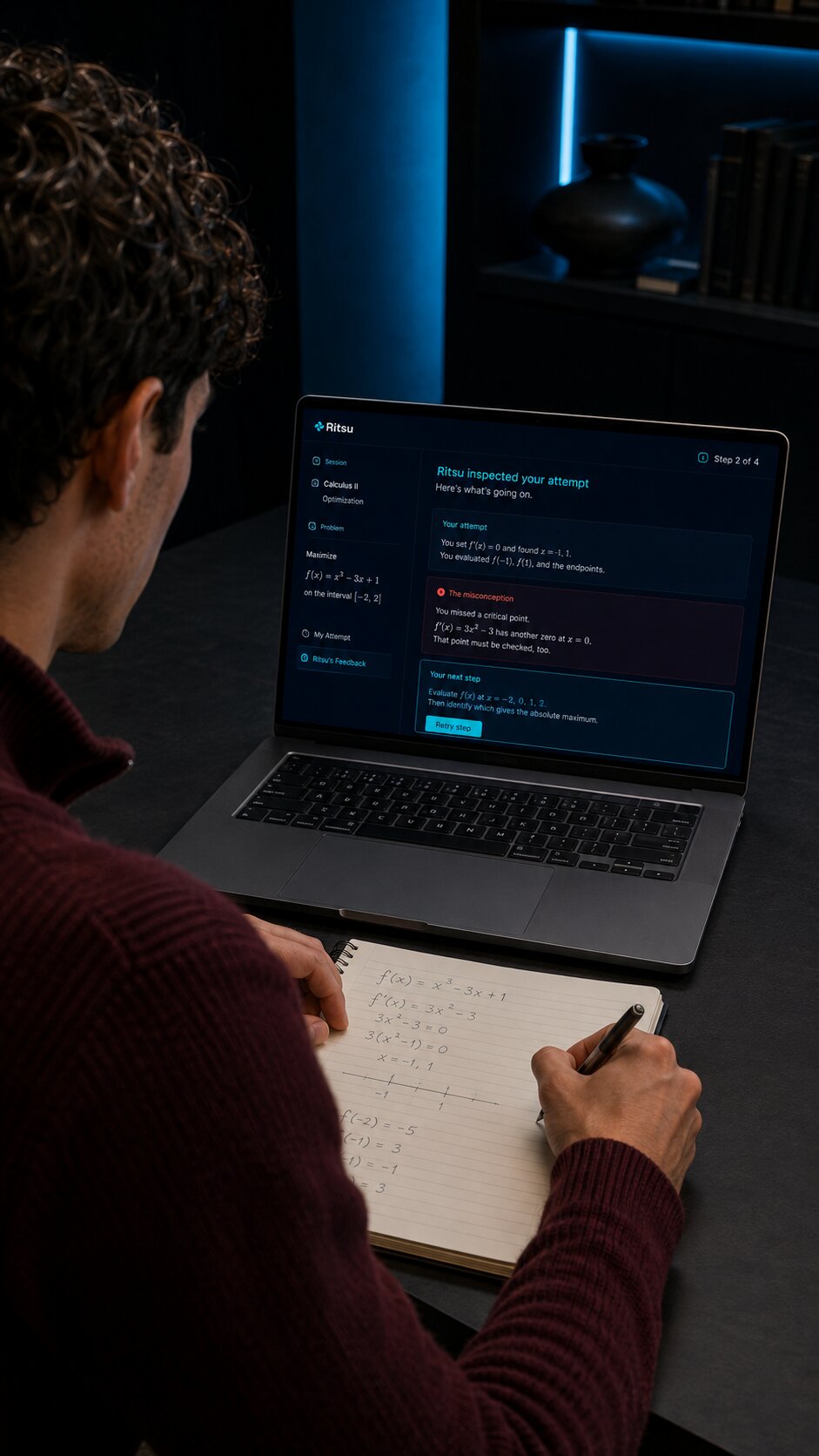
Misconception detection
Page citations
/prereq
Guided retry
Q: Heavier objects fall…fasterat the same rate
misconception foundp.5
You're equating force with acceleration — mass cancels out. Newton's second law, right where you learned it.
guided retry queued → every error leaves you something
Spaced repetition
Beat the forgetting curve. Keep what you learn.
Top students revisit an idea just before it fades — that's the whole trick. Ritsu tracks the moment for you and brings the concept back as a question. No cards to make. Week two is still there in week twelve.
Forgetting curve
Auto-scheduled
From your own file
No cards to make
memory · with Ritsuwithout · it just fades
day 1day 3day 7day 16day 35
each review lands just before you'd forget — no cards to make
Knowledge map
A live map of what you actually know.
Top students know, concept by concept, what's solid. Every answer you give updates one map of your subject, each concept carrying a score you earned — not a self-rating. What you've proven lights up; the dim ones get drilled next.
Concept map
Mastery score
Gap detection
Click to drill in
scores you earned — not self-ratings
All in one
An entire study stack. Not five apps. Just Ritsu.
The top-1% system takes four apps and an evening per chapter to feed: cards to make, summaries to write, practice to hunt down. One upload gives you all of it, from your own material. Nothing to buy on top. Nothing to make.
Quizlet$8/mo
ChatGPT$20/mo
A tutor$30–80/hr
Ankifree + evenings
Your eveningspriceless
QuizzesFlashcards
Ritsu
all in one tool
Worked problemsConcept mapReview schedule
Quizlet Plus $8/moChatGPT Plus $20/moA tutor $30–80/hrAnki free, plus your evenings
Ritsu turns learning science into what you actually do: recall, explain, question, practice, connect, and revisit.
Active Recall
Henry Roediger III & Jeffrey Karpicke (2006)
Instead of showing you the answer, Ritsu asks you to pull it from memory. You produce what you know — and rereading alone never counts as mastery.
question
Why does the minus sign appear in gradient descent?
you answer — from memory
“We step against the slope to go downhill.”
just re-reading
answering from memory
mastered
each retrieval strengthens the trace — reading again doesn't
What changes
What you get — and what you never do again.
You leave behind
You get
No more deciding what to study next.
You don't sit down and build a plan from scratch. Your study time goes into learning, not choosing.
01
A clear path through your material.
Ritsu breaks what you're studying into an ordered path, so the next step is always clear.
No more passive studying.
Rereading, highlighting, and waiting for something to feel familiar are no longer the whole session.
02
A full learning method, built in.
Recall it. Explain it. Question it. Solve with it. Revisit it. Ritsu keeps the whole process in one workflow.
No more mistaking familiarity for understanding.
Seeing an idea before isn't the same as being able to explain it or use it.
03
Understanding you can prove.
Explain it from memory, connect it, solve with it, and apply it before it counts as mastered.
No more getting an answer and moving on.
Being shown the right answer doesn't tell you why your reasoning went wrong.
04
Feedback that finds the real gap.
Ritsu identifies the misconception behind the mistake, then guides you through a retry.
No more guessing what you know.
“I think I know it” doesn't tell you what's solid or where your next hour should go.
05
Your knowledge, made visible.
Every concept carries an earned mastery score, so strengths and gaps are clear at a glance.
No more cram-and-forget.
Learning it for the test only to lose it afterward isn't mastery.
06
Review that keeps knowledge alive.
Ritsu brings concepts back over time, so what you've learned stays within reach.
No more stitching together five study tools.
Files here, flashcards there, a chatbot somewhere else — your learning system shouldn't live across five tabs.
07
One place for the whole workflow.
Upload once, then plan, learn, practice, track, and review in Ritsu.
No more spending an evening preparing to study.
The hours spent preparing to study, before any studying happened, are gone. That was never studying anyway.
08
Your evenings back.
Ritsu builds the setup from your material, so more of your time goes into learning — not preparing to learn.
FAQ
Frequently Asked Questions.
Short answers to real questions — and the free plan is there for whatever's still uncertain.
A file. That's the whole list. Nothing to install, nothing to configure — it runs in the browser. Drop in a chapter and you're working inside a minute.
The choice
Two ways this goes.
Option one
You close this tab. The chapter is still there. You'll open it again on Sunday, read it twice, highlight a bit more, and hope it lands this time. Three weeks from now you're in the same seat, three chapters further behind, still not sure what you actually know. You already know how this one goes — it's why you read this far.
Option two
You start free — no card, nothing to set up. Tonight you drop in the chapter you've been avoiding. Thirty seconds later there's a plan. Twenty minutes later you know exactly which three concepts you don't have. By the weekend you have them — and you do it again with the next chapter, and the one after that.
Same twelve weeks either way. The only thing you're choosing is what you'll have at the end of them.
Nine situations, and a way to shape the plan for each. Whatever's in front of you this week, there's already a path built for it.
Master a textbook chapter
Most students read it twice and keep a fifth. You'll close it understanding every concept deeply — and still understanding it months from now.
See the playbook
the why behind it
Master a lecture deck
Most students skim the slides the night before. You'll master what's behind each one, not just what's printed on it.
See the playbook
0:004 concepts kept2:00:00
Learn from any YouTube video
Paste a YouTube link. Ritsu turns a two-hour lecture into concepts you can actually recall.
See the playbook
page 3 — where most stopyou keep going →
Understand a research paper
Most students stall at page three and quietly give up. You'll understand the argument well enough to explain it, question it, and build on it.
See the playbook
the method
Solve a problem set
Most students read the solution and feel like they understand. You'll understand the method deeply enough to solve every problem like it, not just this one.
See the playbook
Q3
locked
Q4
locked
Q5
locked
Solve a test or exam
Most students check their score and move on. You'll turn every mistake into a concept you've locked down for good.
See the playbook
Remember what you read online
Most students forget it by tomorrow. You'll understand it properly the first time, and still have it when you need it.
See the playbook
Master an entire course
Most students end up with four folders and no thread. You'll have every piece in one place, and learn each one properly instead of half-learning all of them.
See the playbook
day 1day 2day 3
Ace your exam in 3 days
Most students re-read everything and run out of time. You'll spend all three days on the things you'd actually get wrong — deeply enough that they stay.